






Spirit of the Union: The UAE Founding Fathers, History and National Day
Every 2 December, the United Arab Emirates remembers a decision that changed the course of the region: rulers of separate emirates chose to build one country together. The Spirit of the Union is the enduring idea behind that decision. It honours the Founding Fathers, the shared flag and the responsibility of each generation to carry their vision forward. For government entities, schools, businesses and communities, Eid Al Etihad is both a celebration and an invitation to reflect on how unity is lived in everyday service.
What is the Spirit of the Union?
The phrase describes the cooperation, trust and common purpose that made the UAE possible. The union brought distinct emirates, histories and communities into a federal state with shared institutions, while retaining the identity and leadership of each emirate. It is therefore more than a theme for a December event. It points to the work of listening, agreeing on common goals and creating opportunities that reach people across the country.
UAE National Day, now widely celebrated as Eid Al Etihad (Festival of the Union), marks the declaration of the federation on 2 December 1971. It offers a moment to thank the leaders and people who made that step possible, recognise the institutions built since, and look ahead. People experience it through flag raising, cultural programmes, school presentations, public celebrations and family gatherings. A thoughtful celebration tells the story behind the symbols as well as displaying them.
The road to the federation
Before 1971, the emirates along this coast had their own rulers and long traditions of trade, seafaring and community life. The end of Britain’s treaty relationship with the Trucial States created a pressing question about their future. The answer took patient discussions, personal relationships and a willingness to put collective security and development at the centre of a new political arrangement.
A pivotal meeting took place on 18 February 1968, when Sheikh Zayed bin Sultan Al Nahyan, Ruler of Abu Dhabi, and Sheikh Rashid bin Saeed Al Maktoum, Ruler of Dubai, agreed to work toward a federation. Their invitation to other rulers began a broader process of negotiation. The path was neither automatic nor instantaneous: questions about powers, institutions and each emirate’s place in the union had to be settled together.
On 18 July 1971, the rulers of six emirates agreed to form the union. On 2 December 1971, Abu Dhabi, Dubai, Sharjah, Ajman, Umm Al Quwain and Fujairah proclaimed the United Arab Emirates. Sheikh Zayed became its first President, and Sheikh Rashid its first Vice President. Ras Al Khaimah joined on 10 February 1972, completing today’s seven-emirate federation. This sequence matters: the national anniversary commemorates the founding in December, while the seven-emirate union took its complete form the following February.
The founding also required practical institutions. An interim constitution provided a framework for federal government and the responsibilities of the emirates. The new state had to establish common services, represent itself internationally and turn an agreement among rulers into a functioning country. Roads, education, healthcare and administration came to express the union in people’s daily lives. The historical achievement was therefore both a declaration and the sustained work that followed it.
Remembering the Founding Fathers
Sheikh Zayed is known as the Father of the Nation for his leading role in establishing the federation and guiding its early development. Sheikh Rashid was a vital partner in the first agreement between Abu Dhabi and Dubai. The rulers and representatives of the other emirates brought their own judgement and commitment to the negotiations. Remembering them together reflects the central lesson of the union: its strength came from shared consent and cooperation, rather than the achievements of one individual alone.
The official UAE government account identifies the founding rulers of the seven emirates and records Ras Al Khaimah’s later accession. A school or public exhibition can use that official account as the basis for a timeline, then invite visitors to consider what each milestone required: dialogue in 1968, agreement in 1971, declaration in December and the completion of the federation in 1972. This makes a commemorative display more informative than an uncaptioned collection of portraits.
The founders’ example also speaks to the present. A united country can accommodate local character, many languages and different professional communities while sustaining shared civic goals. In a workplace or classroom, the Spirit of the Union can be expressed by helping colleagues, serving the public with care, welcoming residents and telling the history accurately. Those actions are quieter than fireworks, but they make the idea of unity tangible.
Why the UAE flag is central to the story
The national flag was first raised at the declaration of the federation on 2 December 1971. Its red vertical band and horizontal green, white and black bands make it immediately recognisable. Dubai’s Protocol Department describes the flag as a symbol of independence and sovereignty that belongs to everyone. A flag at an entrance or ceremony therefore connects a present-day gathering with the moment the new state was announced.
That symbolism calls for care. Use an accurate flag in good condition, plan its position before installing other decorations, and follow the applicable official flag guidance and each entity’s protocol. Dubai’s Protocol Department advises that flags at a shared ceremony should be displayed appropriately, kept from touching the ground and treated with respect. Do not place a commercial logo over the national flag. A printed motif on a promotional item should never be confused with an official flag intended for a government flagpole.
How government buildings can mark Eid Al Etihad
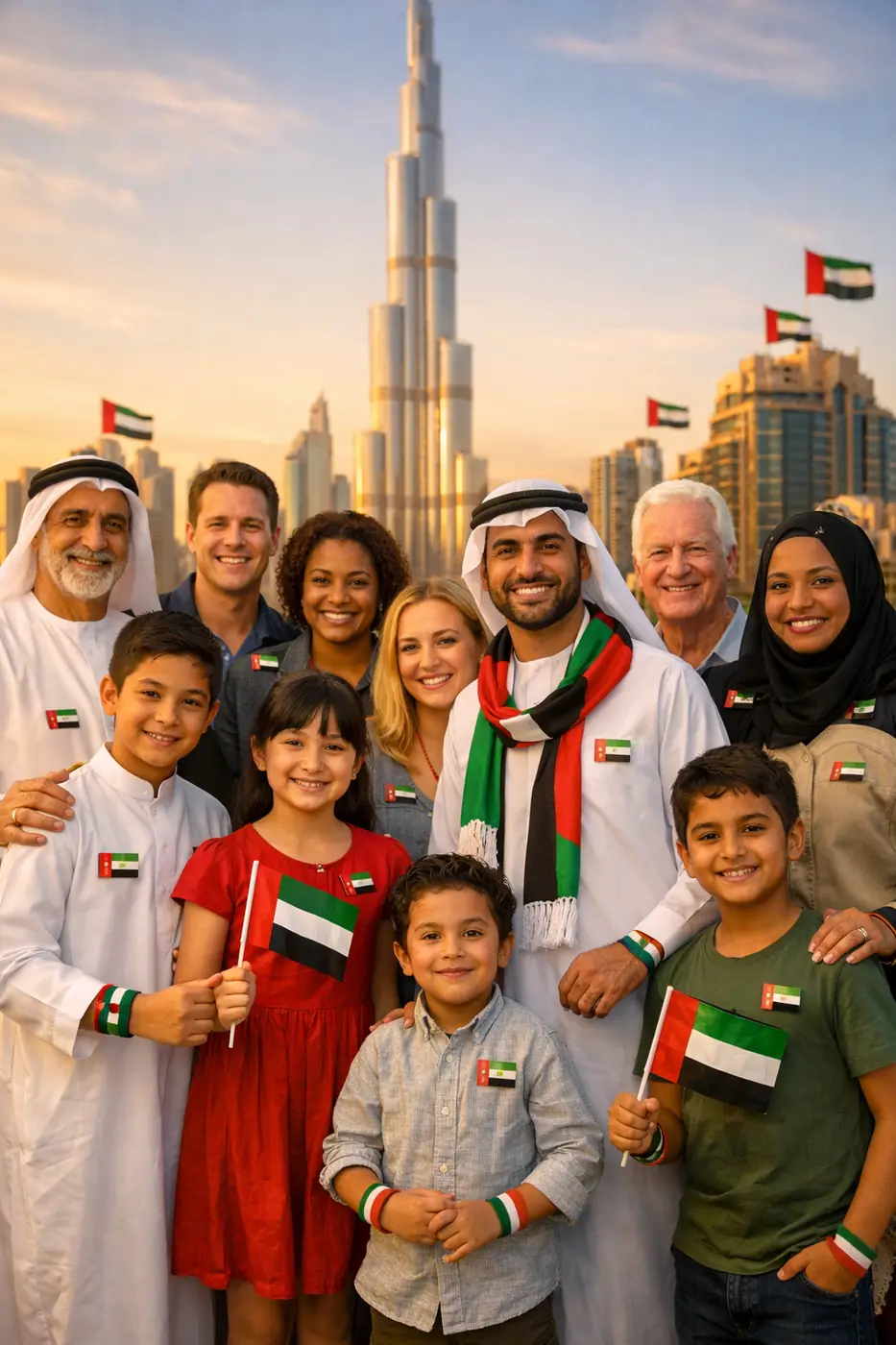
A government building can tell the story visibly before a visitor enters. A well-maintained UAE flag at the designated pole establishes the central symbol. Entrances and public-facing spaces may use approved national colours, event graphics and carefully positioned UAE flag bunting where the facilities and protocol teams permit it. Digital screens can show a concise, verified timeline and an appropriate greeting. The arrangement should remain accessible and should not obscure wayfinding, safety signs or services.
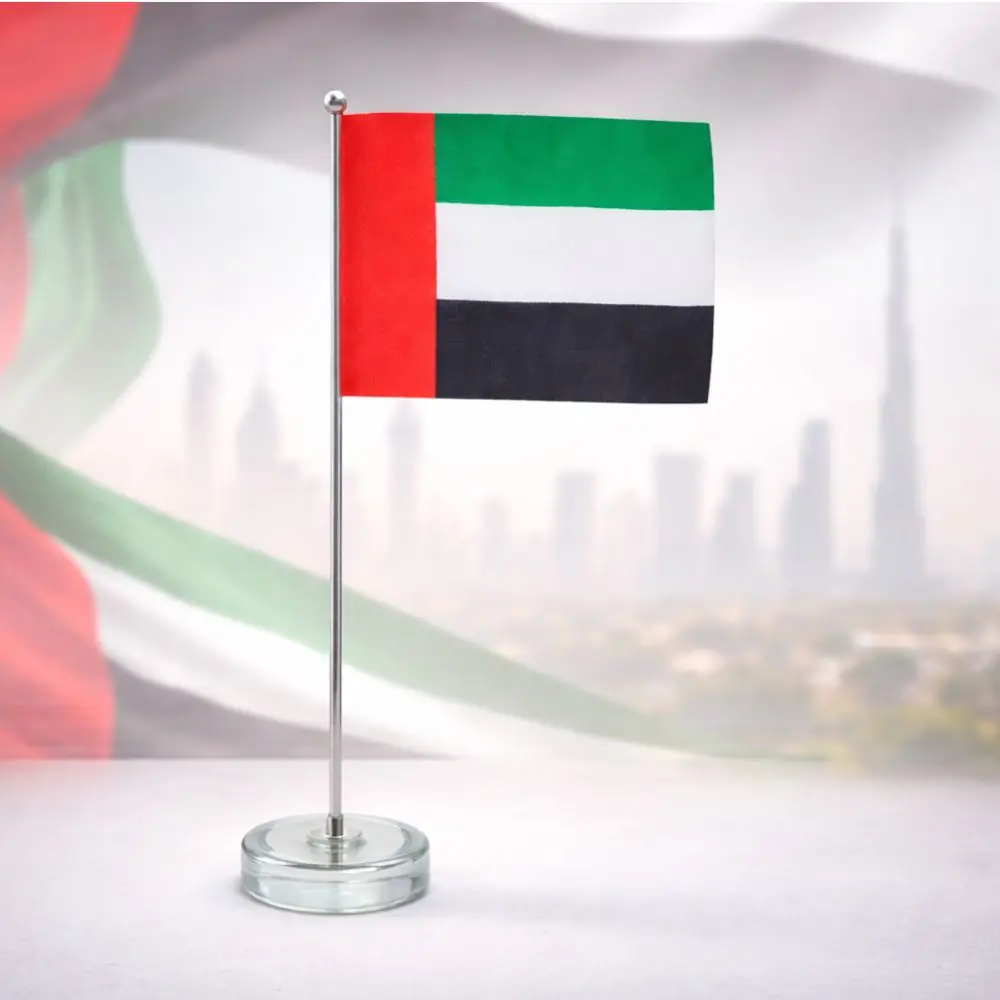
Inside, a reception or lobby can carry the historical message. A simple exhibition might pair the dates 1968, 1971 and 1972 with official captions, a map of the seven emirates and a reading link to the UAE government’s history. A welcome desk may display a small satin UAE flag or a desk flag where appropriate. Staff can explain the display in Arabic and English, and a QR code can lead visitors to official sources. This creates a useful public experience without assuming that every building has the space for a large installation.
A flag raising ceremony, if arranged by the authority, should follow its approved timing, security arrangements and official programme. Some offices add a national anthem, a short historical address, student participation or a community initiative. Others keep the observance quiet because essential services must continue. Staff apparel can be coordinated through approved workplace dress rules: for example, a small UAE flag lapel badge, a Spirit of the Union badge or a flag-themed scarf. These are options for a coordinated event, not universal requirements for government employees.
Outdoor lighting and larger façade treatments require their own approvals, technical checks and maintenance plan. Facilities teams should consider wind, attachment points, electrical safety, access routes and the building’s architectural rules. The most effective display is often restrained: a properly presented flag, a clear historical explanation and welcoming staff can say more than an overcrowded façade. When official campaign identities or portraits are used, obtain current artwork and usage permission from the relevant authority instead of adapting a past year’s logo.
National Day and Flag Day: related, but different
These occasions share the national flag but remember different events. UAE Flag Day is observed on 3 November and centres on a collective expression of loyalty and unity through raising the flag. Eid Al Etihad on 2 December commemorates the establishment of the federation in 1971. Some organisations plan one season of patriotic activities across both dates; their communications should still label the occasions correctly. A 3 November flag ceremony is not the 2 December founding declaration.
That distinction is helpful for planning. Flag Day messaging can focus on the flag and its respectful display. A National Day programme has room for the founding story, the seven emirates, culture, service and community participation. Materials with a printed anniversary number should be checked each year; timeless flag products and historically accurate displays can be reused more easily.
Ideas for schools, offices and community programmes
A school can invite pupils to build a timeline from reliable sources, research one emirate each, or describe what cooperation meant to the founding process. A cultural showcase can feature poetry, music, crafts and family stories, with room for students from different backgrounds to participate respectfully. National Day clothing and accessories can support a themed school event when they fit the school’s own dress guidance.
An office might begin with a short talk about the 1968 agreement and the 1971 declaration, then recognise colleagues whose work serves the community. Teams can create a bilingual information wall, host a heritage conversation or organise a volunteering activity. For a public-facing team, consistent magnetic flag badges or scarves can complement existing uniforms without replacing official identification. Choose comfortable, secure fittings for the work being done.
Event organisers can offer visitors a keepsake that leads back to the story: a small flag with a timeline card, a badge with an explanatory insert, or a curated National Day gift set. Keep the historical explanation and event identity legible; avoid an unsupported claim that an item is officially endorsed. For large distributions, confirm quantities, customisation, lead time and venue rules before finalising the programme.
Planning flags, badges and accessories for an event
Begin with the purpose of each item. A building flag serves a protocol role; handheld flags help participants join a gathering; string flags and bunting can define a suitable event area. Flag badges are compact for reception and event teams, while National Day scarves add colour to approved uniforms. These product formats meet different needs; none substitutes for a correctly specified ceremonial flag.
When ordering, note indoor or outdoor use, dimensions, material, mounting method, number of staff and distribution points. Ask for a sample or artwork proof if branding or a custom message is required. Decide whether the product should carry the national colours alone, an authorised event identity, or the organisation’s branding beside a separate flag graphic. A current inventory and final proof help avoid outdated anniversary dates and inaccurate colours.
GiftSuppliers.ae offers a broader UAE National Day range for schools, companies and event teams, including flags, badges, accessories, scarves and gift sets. For a coordinated programme, send the venue, audience, quantities and deadline so suitable products can be matched to the display plan. The strongest National Day presentation begins with the history and uses merchandise to support it.
Carrying the union forward
The founding of the UAE was a deliberate act of partnership. Its dates and leaders deserve to be remembered precisely, and its flag deserves respectful treatment. Yet the Spirit of the Union also asks what people do with that inheritance. Public service, learning, inclusion and cooperation keep a founding idea relevant well after the decorations come down. On 2 December, a thoughtful flag display, a well-researched story and a shared celebration can honour the Founding Fathers while helping the next generation understand why their decision still matters.