






History and Meaning of the UAE Flag
The flag of the United Arab Emirates is a visible sign of the federation formed on 2 December 1971. Its red, green, white and black design is familiar at government buildings, schools, ceremonies and celebrations. Understanding how it was chosen gives the flag more meaning than a decorative pattern: it recalls the decision of the emirates to create a shared state.
How was the UAE flag chosen?
According to Dubai’s Protocol Department, Abdulla Mohammed Al Ma’enah designed the flag after seeing a competition advertised in Abu Dhabi’s Al Ittihad newspaper. The competition was held before the federation was announced. About 1,030 designs were entered and six were shortlisted. His design was selected for the new country’s national flag.
The flag was first raised on 2 December 1971 at the declaration of the UAE federation. Sheikh Zayed bin Sultan Al Nahyan was the first to hoist it. Six emirates founded the state that day; Ras Al Khaimah joined on 10 February 1972. These dates explain why the flag is associated so closely with National Day, now celebrated as Eid Al Etihad.
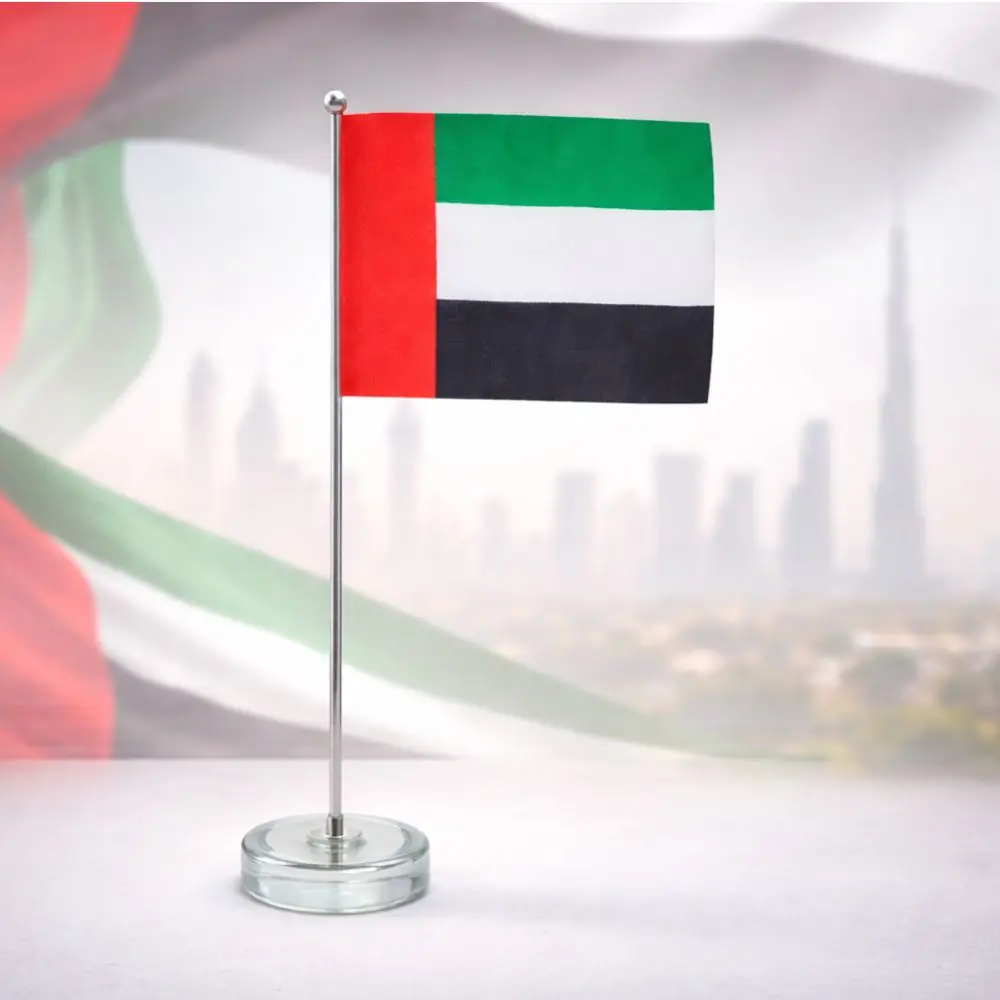
What do the design and colours represent?
The flag is rectangular, with a vertical red band beside three horizontal bands: green at the top, white in the middle and black at the bottom. Dubai’s Protocol Department specifies a length twice its width and explains that the designer drew inspiration from a poem by Safi-u-ddin Al Hali. Many simplified colour interpretations circulate online; for an official or educational display, use the verified design and cite the authority rather than assigning an unsupported single meaning to each colour.
The colours together became a common national symbol at a time when the federation was taking shape. The flag stands for a sovereign state and is displayed across national, official and public events. It belongs to the whole country, not to a particular product, company or occasion.
The flag and the Spirit of the Union
Sheikh Zayed of Abu Dhabi and Sheikh Rashid of Dubai agreed in February 1968 to work towards a federation. Their discussions with the rulers of the other emirates led to the declaration in December 1971. The new flag gave that shared decision a clear visual identity. Today, raising it can recall both the founding moment and the continuing work of cooperation among the emirates.
Read our full Spirit of the Union account for the founding timeline, the Founding Fathers and ideas for thoughtful public celebrations.
Displaying the flag respectfully
A national flag used for formal display should be accurate, clean, well maintained and suited to its setting. Dubai’s Protocol Department advises that flags should not touch the ground and describes the appropriate order of raising and lowering flags at shared ceremonies. Government entities and event venues should follow their own current official protocols and the UAE Flag Usage Guideline when planning placements, poles or large public displays.
A handheld flag, an official-format building flag and a flag motif printed on merchandise serve different purposes. Do not overlay a company logo on an official national flag or imply that a themed promotional product has government endorsement. When planning outdoor installation, check safe mounting, wind conditions and visibility as well as the applicable display rules.
Flag Day and Eid Al Etihad
UAE Flag Day on 3 November and Eid Al Etihad on 2 December are related but distinct. Flag Day centres on the flag as a shared expression of unity. Eid Al Etihad commemorates the formation of the federation in 1971. A school or company may plan activities around both, but should label the dates accurately and explain their different histories.
From federation to everyday symbol
The story does not end with the first flag raising. A federation needs schools, public institutions, shared services and a sense that people in different emirates belong to the same national project. The flag became a consistent image at those points of contact. It can appear above an institution, beside a speaker at a formal event or in the hands of children learning the country’s history. The meaning of the setting matters: a well-presented flag at a ceremony is a reminder of the founding agreement, not simply a colour scheme for a photograph.
That context is especially useful when preparing a National Day programme. A display can pair the flag with three verified milestones: the 1968 agreement between Sheikh Zayed and Sheikh Rashid, the founding declaration on 2 December 1971, and Ras Al Khaimah’s entry on 10 February 1972. Visitors can then connect the image they see with the choices and people behind the federation. If a portrait or archival image is added, its names, date, rights and caption should be checked against an authoritative source.
Choosing a flag for a venue
Before ordering, establish whether the flag will be displayed indoors, outdoors, on a desk or in participants’ hands. A ceremonial indoor flag may need a suitable stand and finishing; an outdoor flag calls for an appropriate fabric, reinforced edge and mounting method. A desk flag needs a stable base and scale suited to the reception or meeting room. A handheld flag is designed for distribution and can be sized for an audience. These are procurement considerations; the precise product specifications should come from the listing or a confirmed quotation.
For an event involving several countries, confirm the order, relative height and placement of flags with the protocol team. Do not assume that the layout for a private party is suitable for a government building or diplomatic event. Replace damaged or faded flags before a ceremony. Public spaces also require clear entrances, safe rigging and accessible routes, so coordinate installation with the venue rather than treating a flagpole or façade as a simple decoration point.
Using flag-inspired designs on merchandise
The UAE colours can be carried through scarves, badges, caps, apparel and gift packaging for a celebration. Such items help staff and guests participate, but their design should be clearly distinguished from a formal national flag. Use correct artwork and avoid changing the geometry of the flag in a way that suggests an inaccurate official version. For government logos, official anniversary identities and photographs of leaders, obtain permission and the current approved artwork before printing.
Buyers planning a large distribution should agree on the intended audience, sizes, artwork, material, quantities and delivery timetable first. A sample or proof is particularly helpful for colour matching and a personalised message. The product grid on the UAE collection page shows existing listings; additional formats will be added only after their specifications, photography and prices are ready. That keeps a useful distinction between an idea for future production and an item a customer can actually order now.
Explore UAE flag products
For celebrations and event programmes, browse UAE flags and related products or the current flag catalog. Product pages show the actual options available. If you need a size, finishing method or quantity not listed, send an enquiry so it can be specified and quoted.